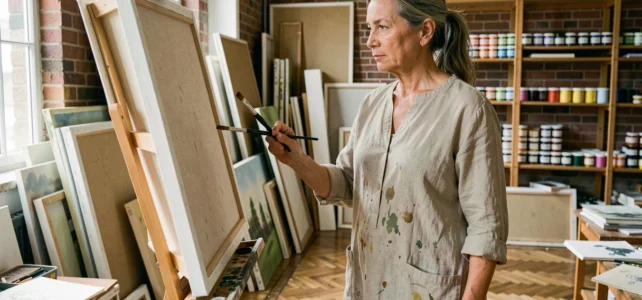
Béatrice Vonderweidt is a former model turned painter, also known as Béatrice Goldnadel. Her journey attracts curiosity online, but much of the content published about her focuses on her private life rather than her artistic work. Her photos circulate abundantly, while her paintings are much less visible.
When Béatrice Vonderweidt’s Photos Eclipse Her Paintings
Have you ever noticed that when you type her name into a search engine, the results rarely mention painting? Almost all recent uses of “Beatrice Vonderweidt photos” serve to illustrate ancillary topics: supposed private life, the journey of a “discreet muse,” curiosity surrounding her relationship with Gilles-William Goldnadel.
This gap between the public persona and the artist is striking. Her paintings are almost absent from search results, replaced by portraits and snapshots from her modeling past. The phenomenon illustrates a well-documented mechanism: the less a personality publishes themselves, the more third-party content defines their online image.
To better understand Béatrice Vonderweidt’s photos and her journey as a painter, it is essential to distinguish between what pertains to media curiosity and what genuinely documents her artistic work.
Her Pinterest profile, for example, exists under the name “Beatrice Goldnadel Vonderweidt.” One might expect to find reproductions of her canvases there. In reality, it is dedicated to DIY and crochet, not to showcasing her artistic creations. No digital showcase presents her painter’s catalog.
Exhibitions in Tel Aviv: Verifiable Traces of a Painting Career
If one seeks concrete evidence of her artistic activity, two events stand out from public archives. Both took place in Israel, in Tel Aviv.
The first is an exhibition titled “Regards croisés,” organized in 2008 at the French Institute in Tel Aviv. A publication from the French Embassy in Israel explicitly presents her as a painter under the name Béatrice Goldnadel. This document constitutes one of the few institutional sources confirming her status as an artist.
The second is her participation in an exhibition at the Caprice Gallery in 2016, also in Tel Aviv. These two exhibitions are the only verifiable public traces of her painting journey, which does not mean she has not exhibited elsewhere, but that the rest is not documented by accessible primary sources.
Why Tel Aviv and not Paris?
The connection to Israel is partly explained by the background of her husband, Gilles-William Goldnadel, a French lawyer and essayist who chaired the France-Israel association from 2004 to 2018. This context has likely facilitated connections with the local cultural scene.
The absence of a listed exhibition in France does not lead to the conclusion of an exclusively Israeli career. It rather reflects a choice of discretion that characterizes her entire approach.
Béatrice Vonderweidt and the Right to Image in France
The massive circulation of her photos online raises a concrete question: what does French law say about the use of images of a person without their consent?
In France, the right to image is protected by Article 9 of the Civil Code. Every person has an exclusive right over the dissemination of their image. Publishing a photograph without permission can lead to legal action, even if the person is or has been a public figure.
For Béatrice Vonderweidt, the situation is paradoxical. Her former career as a model involved a consented dissemination of her photos within a specific professional context. But the reuse of these images out of context is not automatically permitted. A portrait taken for an advertising campaign in the 1990s cannot be freely republished on a blog in 2026.
Several sites reuse her images to attract traffic on topics unrelated to her work. This type of practice poses problems on several levels:
- The initial consent, given for a specific commercial use, does not cover unlimited redistribution on the internet
- Associating her image with speculative content about her private life may constitute an invasion of privacy under French case law
- The absence of public reaction from her does not imply tacit acceptance from a legal standpoint
From Modeling to Painting: What This Journey Reveals About Artistic Visibility
The transition from modeling to painting is not trivial. These two activities maintain an inverse relationship to visibility. Modeling relies on the exposure of the body and face. Painting, especially when practiced independently, can be done in relative anonymity.
Béatrice Vonderweidt embodies this tension. Her online notoriety comes almost entirely from her first career and her marriage, not from her canvases. The public seeks the muse, not the painter.
This imbalance is not unique to her case. Many artists who have had a public life in another field face the same issue: the search engine retains the most spectacular identity, not the most current one.
Some Tips for Existing as an Artist Online
The rarity of her digital presence as a painter offers a case study. For an artist to exist online through their work, a few elements make a difference:
- A personal website or an online gallery showcasing the works with descriptions, dates, and exhibition locations
- Regular publications on art-oriented visual platforms, not DIY
- Mentions in exhibition catalogs or specialized journals, which constitute sources indexed by search engines
Without these elements, the algorithm fills the void with what it finds: youth photos, curiosity articles, speculations.
Béatrice Vonderweidt’s journey reminds us that artistic visibility is not built by default. An artist who does not document their own work allows others to define it for them. In her case, the photos have overshadowed the paintings, and search engines have frozen an image that no longer corresponds to what she does today.