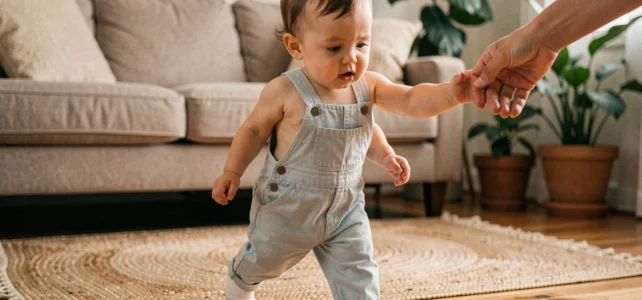
The autonomous walking of a young child engages muscle chains, proprioceptive loops, and a vestibular system whose maturation cannot be decreed. Supporting your child’s first steps requires understanding what is happening beneath the surface, far beyond generic advice on encouragement and patience.
Proprioception and motor schema: what barefoot walking really brings
The foot of a young walker contains a density of mechanoreceptors comparable to that of the hand. Each direct contact with the ground sends information to the brain about the texture, slope, and hardness of the surface. This sensory feedback fuels the construction of the motor schema for walking.
We recommend barefoot walking on varied surfaces (wood, carpet, grass, tile) whenever safety allows. Barefoot remains the best learning tool as long as the child is indoors or on a clean, safe outdoor surface.
Outside, wearing shoes becomes necessary for protection. The selection criteria have evolved: health professionals now prioritize a very flexible sole and a wide toe box, without excessive rigid support. A shoe that is too structured restricts the mobility of the metatarsophalangeal joints and deprives the brain of some proprioceptive information. Many families find useful guidelines for footwear and motor milestones on mespetitspas.fr, which details these criteria based on age.
A often overlooked point: recheck the shoe size approximately every month. The foot grows quickly at this age, and shoes that have become too small hinder learning more than slightly larger shoes.
Postural tone and free motor skills: preparing for walking before walking
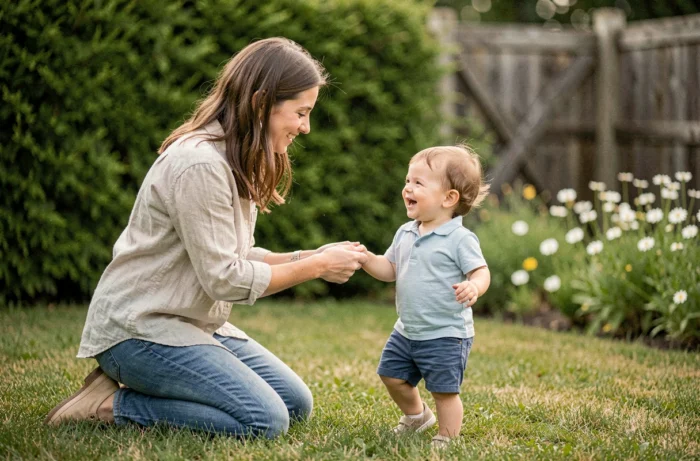
Walking does not begin the day the child lets go of the furniture. It is prepared through months of rolling, crawling, creeping, and transitions from sitting to standing. Each step builds axial tone (trunk and pelvic muscles) without which standing balance is impossible.
Free motor skills, as described in Emmi Pikler’s approach, rely on a precise technical principle: do not place the child in a posture they cannot achieve on their own. Sitting a baby who cannot sit yet creates a muscular compensation that can delay the acquisition of standing. Holding them up by the arms short-circuits the core work necessary for stable walking.
In practice, this involves a clear space on the floor. A firm mat, a few motivating objects placed at increasing distances, and stable low furniture for lateral support are sufficient. Wheeled walkers, on the other hand, pose a biomechanical problem: they shift the center of gravity forward and engage the toes instead of the heel-to-toe roll.
Walking on tiptoes: spotting a clinical signal
Many children go through a transitional phase of walking on tiptoes at the very beginning of acquisition. This pattern generally disappears spontaneously within the first weeks of autonomous walking.
The situation changes if tiptoe walking persists beyond this initial period, especially when accompanied by one of the following signs:
- Noticeable stiffness at the ankles, with difficulty placing the heel on the ground even at rest
- Clear asymmetry between the two feet, with one side consistently remaining on tiptoes
- Expressed pain or refusal to walk after a few steps
These factors warrant a prompt medical evaluation rather than a simple change of shoes or prolonged waiting. An assessment by a pediatrician or pediatric physiotherapist can distinguish a transient habit from a shortening of the Achilles tendon or an underlying neurological disorder.
Safe environment and overall child development
Public health organizations place walking within a broader context: motor development depends on repeated interactions, free play, appropriate nutrition, and a secure environment. Reducing the support of first steps to a precise technique overlooks this reality.
In practical terms, securing the walking space requires some targeted adjustments:
- Secure tall and narrow furniture (bookshelves, dressers) to the wall, as the child uses them to pull themselves up
- Remove rugs with raised edges or slippery surfaces that can unbalance a beginner walker
- Clear pathways between rooms to allow continuous routes, which are more motivating than back-and-forth movements in a confined space
- Maintain sufficient lighting on the floor, as shadows can disrupt depth perception in very young children
The adult’s role is to remain available nearby without physically guiding. Extending arms at a reasonable distance serves as a visual and emotional reference. Consistently catching the child before they fall deprives them of proprioceptive information about their balance limits.
Falls and learning balance
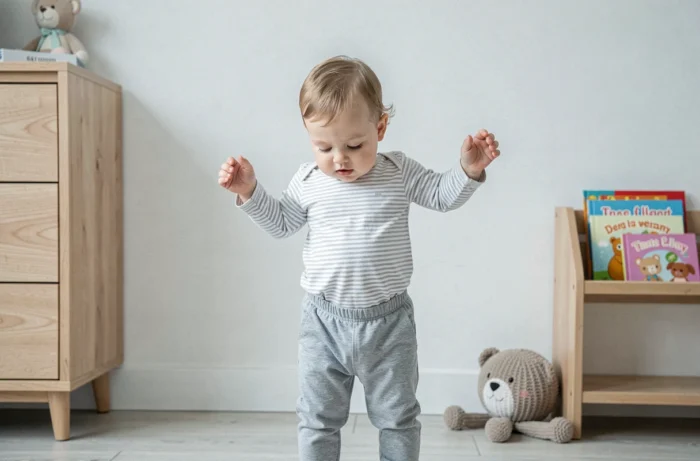
Falling is an integral part of the neuromotor process. Each imbalance triggers a postural reaction that, through repetition, refines adjustment reflexes. A child who falls on their bottom from their height onto an appropriate surface does not get hurt and gains useful sensory data.
The adult’s reaction to the fall impacts the child’s confidence. A calm look after a minor fall reassures more than a hasty intervention. The child reads the parental facial expression to calibrate their own emotional response.
The acquisition of walking does not follow a linear timeline. Some children walk early and temporarily revert to crawling. Others skip crawling and go straight to standing. These variations are part of normal development as long as overall progression is maintained and no clinical warning signs appear. The only reliable reference remains regular observation, shared if necessary with a health professional.