The Henriot Quimper earthenware is a ceramic with a porous body, fired at moderate temperatures and covered with a stanniferous glaze. This structure makes it sensitive to shocks, acidic products, and clumsy handling. Before cleaning or attempting any repairs, it is essential to understand what the glaze tolerates and what can cause irreversible damage.
Stanniferous glaze and porosity: what makes Henriot earthenware fragile
The stanniferous glaze that covers Henriot pieces is a vitrified coating based on tin. It ensures the impermeability of the surface and protects the hand-painted decoration. Beneath this glaze, the body remains porous.
Any crack or chip in the glaze layer exposes the body to moisture. Water infiltrates by capillarity, causing deep brown stains and can weaken the structure of the piece over time. That is why a chipped piece should never soak in water.
The decoration applied under the glaze (a characteristic technique of Quimper earthenware) withstands light friction well, but it is vulnerable to chemicals that attack the vitrified layer. Acids, chlorinated solvents, and mechanical abrasives can dull or partially dissolve the glaze, making the damage impossible to correct without professional intervention. To better identify the period and value of your pieces, you can also learn how to date a Henriot earthenware with iDéco Maison before any handling.
Regular cleaning of Quimper earthenware: protocol with neutral surfactant
Old guides often recommend white vinegar or baking soda. These products are now discouraged for collectible earthenware. Vinegar, being acidic, gradually attacks the stanniferous glaze. Baking soda, slightly abrasive, can scratch the painted decorations.
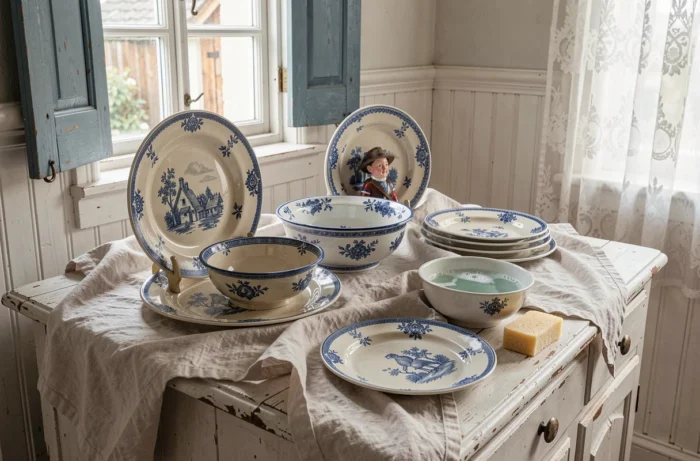
The protocol recommended by conservation specialists relies on a diluted neutral surfactant in warm water. Specifically, a few drops of liquid Marseille soap (without additives) in a basin of room temperature water are sufficient.
Here are the steps to follow for risk-free cleaning:
- Moisten a soft sponge (never the abrasive side) in the soapy solution, then gently wipe the surface of the piece without rubbing in strong circles.
- Immediately rinse with a clean cloth soaked in clear water to remove any soap residue, which could leave a dull film as it dries.
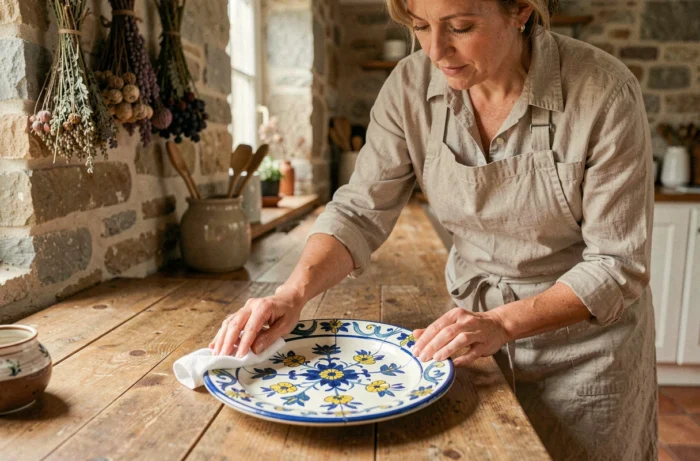
- Dry immediately with a soft, dry cloth, patting rather than rubbing, to avoid lime marks and limit the contact time of water with the glaze.
For regular dusting between washes, a soft-bristled brush (like a large makeup brush) allows you to reach the reliefs of the decoration without applying mechanical pressure on the glaze.
Home restoration of Henriot earthenware: the limits to know
Bernard Verlingue, curator of the Quimper earthenware museum, regularly warns during appraisal days: the main threat to old earthenware is no longer breakage, but irreversible home restorations. Modern glues, glossy varnishes, and acrylic paint touch-ups significantly devalue pieces and complicate any subsequent conservation work.
His recommendation is clear: on a piece with a loss, a through crack, or a significant chip, do not intervene yourself. A simple gentle dusting is sufficient while waiting for a specialist’s opinion.
What can be done at home
For a micro-chip on a daily-use piece (a bowl, a plate without collectible value), a spot re-gluing may be justified. Cyanoacrylate glue (type “super glue” gel) provides a fine and transparent bond. Apply a minimal amount with a toothpick, hold the fragments under gentle pressure for a few minutes, then let dry without handling for several hours.
Never use tinted epoxy glue or putty on a piece that may have heritage value. These products penetrate the porosity of the body and become almost impossible to remove cleanly.
What requires a professional restorer
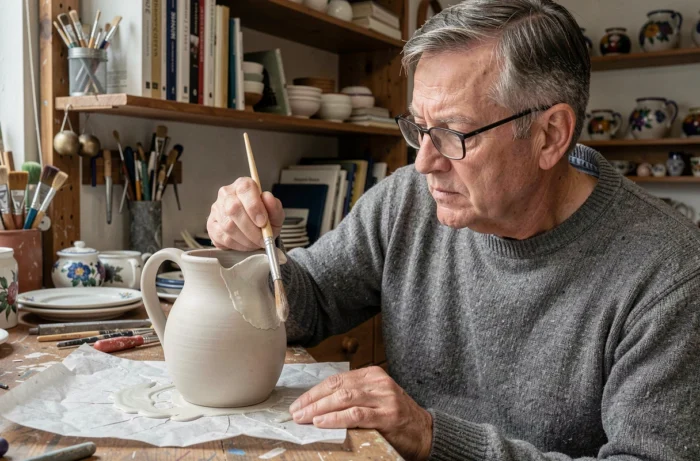
Any intervention involving the reconstruction of missing material, retouching of decoration, or filling of glaze exceeds the domestic scope. Trained restorers use reversible materials (animal glues, compatible pigments) that allow for reversibility if necessary. It is this reversibility that distinguishes quality restoration from damaging DIY work.
Daily conservation of Quimper earthenware pieces
Storage and display condition the longevity of pieces as much as cleaning. A few precautions significantly reduce the risks of degradation:
- Stack plates with a textile felt or a disk of tissue paper between each piece to avoid friction of glaze against glaze, a source of cumulative micro-scratches.
- Secure displayed pieces on shelves with appropriate supports (plate stands, anti-vibration bases) rather than balancing them against a wall.
- Avoid prolonged direct exposure to sunlight, which can alter certain pigments of the decoration, particularly the reds and yellows characteristic of the Henriot manufacture.
- Never place an antique earthenware in the dishwasher or microwave: thermal shocks weaken the glaze and accelerate crazing.
Crazing (a network of micro-cracks in the glaze) is a natural phenomenon on old earthenware. It is not a defect to correct, but a sign of age that collectors appreciate. Attempting to mask it with a varnish amounts to distorting the piece.
Ultimately, maintaining a Henriot Quimper earthenware relies on a simple principle: intervene as little as possible, with the gentlest products. The pieces that survive the decades in the best condition are almost always those whose owners had the wisdom not to touch them too much.