
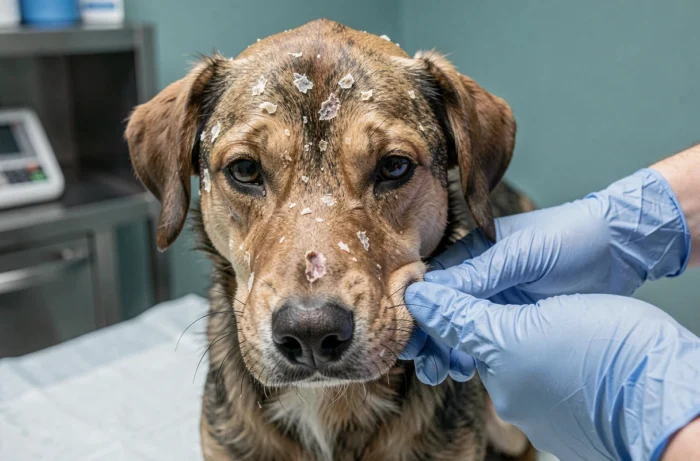
When faced with a dog that is scratching, losing hair in patches, or showing persistent redness, the usual reflex is to look for a kibble labeled “sensitive skin.” The choice is based on specific criteria, measurable on the label, and on a testing protocol whose duration determines the reliability of the result. This article compares the key nutrients and labeling traps that separate a truly suitable kibble from a mere marketing argument.
Proteins, omega, and zinc: what the label says about sensitive skin kibble
All manufacturers highlight the same promises, but the analytical compositions reveal significant discrepancies. The table below summarizes the nutrients whose role in skin barrier and inflammation is documented in veterinary nutrition.
| Nutrient | Role on the skin | What to read on the label |
|---|---|---|
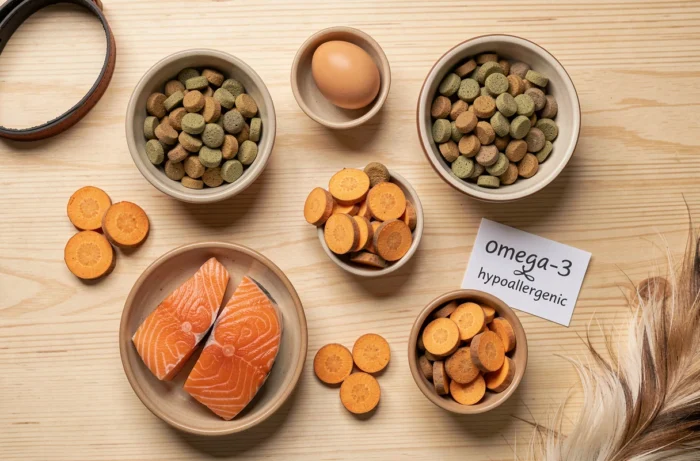
| Omega-3 (EPA, DHA) | Reduction of skin inflammation | Named source (fish oil, salmon oil), not just “fats” |
| Omega-6 (linoleic acid) | Integrity of the skin barrier | Present in sunflower oil, poultry fat |
| Zinc | Healing, cell renewal | Mentioned in nutritional additives, ideally in chelated form |
| Copper | Collagen synthesis, coat pigmentation | Present in additives, often associated with zinc |
| Vitamins A and B | Regulation of sebum, hair health | Visible dosage in nutritional additives |
| Main protein | Renewal of skin tissues | Single, named source as the first ingredient (salmon, lamb, duck) |
One detail separates serious formulations from others: the source of omega-3 must be explicitly named. A generic mention of “oils and fats” does not guarantee the type of fatty acid or its concentration. Fish oils (salmon, herring) provide EPA and DHA directly, while vegetable oils mainly supply ALA, a precursor that dogs convert very poorly.
To deepen the selection of an appropriate formula, the guide on anti-itch kibble for dogs on Syntonie Animale details the compositions to favor according to the type of skin disorder.
Single protein or hydrolyzed: what type of kibble according to the diagnosis
The choice between a single protein kibble (known as “novel protein”) and a hydrolyzed protein kibble depends on what the veterinarian suspects. The two approaches do not target the same mechanism.
Novel protein kibbles
They rely on a protein source that the dog has never consumed: duck, deer, insect, sometimes kangaroo. The idea is simple: the immune system cannot react to a protein it has never encountered. This option works well in the context of an elimination diet aimed at identifying a food allergy.
The limitation is practical. Many industrial kibbles contain traces of several animal proteins (cross-contamination in factories). A label displaying “duck” as the sole ingredient may contain residues of chicken if the production line is not dedicated.
Hydrolyzed protein kibbles
Here, the proteins are broken down into peptides so small that the immune system no longer recognizes them as allergens. This is the reference format in veterinary dermatology for confirmed cases of food allergy or severe atopy. However, their cost is significantly higher and their palatability sometimes lower.
A veterinary hydrolysate remains the most reliable choice for a diagnosed atopic dog, while a novel protein is more suitable in the exploratory phase.
Elimination diet: why a food trial lasts at least eight weeks
Changing kibbles for two weeks and concluding that “it doesn’t work” is the most common mistake. The current consensus in veterinary dermatology sets the minimum duration of a food trial between eight and twelve weeks. This period corresponds to the time needed for the skin’s inflammatory response to decrease measurably after the allergen is removed.
During this period, the protocol requires total rigor:
- One single source of protein and one single source of carbohydrate, with no extras (treats, table scraps, flavored chew bones)
- No formula changes during the test, even if improvement seems slow in the first weeks
- A photographic follow-up of skin lesions to objectify the evolution, rather than relying on the general impression
If symptoms improve significantly at the end of the trial, the next step is to reintroduce the old proteins one by one to identify which one triggers the reaction. Without this reintroduction phase, the diagnosis of food allergy remains a hypothesis.
Emerging contaminants in kibbles: an overlooked criterion for skin health
Discussions about sensitive skin kibbles almost exclusively revolve around proteins and omegas. One angle remains absent: the presence of contaminants in the raw materials used by manufacturers.
The European Union has recently strengthened the monitoring of several substances in animal feed, notably pyrrolizidine alkaloids, ergot alkaloids, and PFAS, based on risk assessments published by the EFSA. These contaminants are studied for their effects on the liver, immune system, and endocrine system, all functions whose disruption can worsen chronic skin inflammation or amplify an allergic response.
In practice, this means that a manufacturer who communicates about their compliance with the latest EFSA opinions and their contaminant controls offers an additional guarantee. This criterion does not appear on any consumer label, but some manufacturers publish their batch analyses upon request.
- Check if the manufacturer mentions a contaminant monitoring program for their raw materials
- Prefer brands that display traceability of their animal and plant sources
- Request recent analysis certificates from customer service if the dog has skin issues resistant to conventional dietary changes
A dog whose itching persists despite a well-conducted elimination diet and sufficient omega-3 deserves that the overall sanitary quality of its kibble be examined, beyond the simple ingredient list.