A child’s development is built through repeated daily interactions, not during exceptional moments. Every exchange, every routine, every shared silence shapes how a child perceives the world and their place in it. Supporting this process requires understanding some concrete mechanisms, including emotional regulation, the arrangement of the family environment, and screen management.
Parental technoférence and shared attention: an underestimated barrier
The term technoférence refers to the repeated interruption of parent-child interactions by a smartphone or another screen. This phenomenon, documented by the Mustela Foundation in a summary published in 2026, constitutes a direct barrier to children’s emotional and cognitive development.
The problem is not limited to the child’s screen time. When a parent checks their phone during a meal or a shared activity, the child perceives a break in the attention given to them. This micro-disruption, seemingly trivial, alters the quality of the bond if it happens several times a day.
Reducing technoférence does not require giving up technology. Simple gestures, such as placing the phone out of visual reach during meals or playtime, are enough to restore fully available attention. The resources compiled on the dedicated children’s page on Mister Papa address this type of parenting practice from various angles.

Children’s emotional management: learning to name before regulating
A child who hits, screams, or withdraws often expresses an emotion they do not yet know how to identify. Emotional management begins with vocabulary work, not with a breathing technique.
Naming an emotion accurately changes how the brain processes it. Saying “you are frustrated because your drawing doesn’t look like what you imagined” is more helpful than a generic “calm down.” The child gradually learns to distinguish anger from frustration, sadness from disappointment, fear from anxiety.
Three common situations to practice
- After a conflict between siblings: ask each child to describe what they felt before seeking a solution. This step slows down the automatic reaction and establishes a reflex of introspection.
- After school: instead of asking “did it go well?”, asking a precise question like “what surprised you today?” opens a richer space for conversation.
- In the face of failure (grade, lost match, failed activity): acknowledge the disappointment out loud before offering encouragement. Validating the emotion always precedes the search for a solution.
Family environment and activities at home: structuring without rigidifying
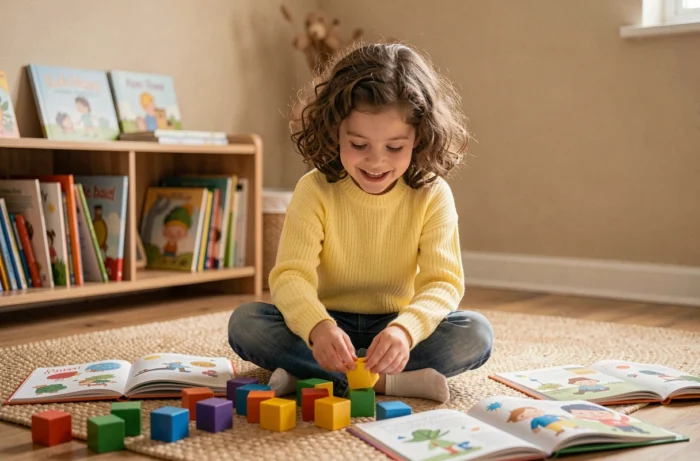
The physical space in which a child evolves directly influences their autonomy. A family environment designed for the child does not mean a home turned into a classroom, but rather an arrangement that allows them to act independently on certain tasks.
Placing glasses at their height, installing a stable step stool near the sink, storing toys in accessible bins: these adjustments reduce the number of requests for help and reinforce the feeling of competence. A child who can pour themselves a glass of water without asking an adult gains confidence, even if the action seems trivial.
Free activities versus directed activities
The trend to fill every slot with a structured activity (sports, music, language classes) leaves little room for boredom. Yet, boredom triggers creativity and personal initiative.
An effective balance consists of alternating periods of structured activities with times when the child has materials (paper, crayons, cardboard, fabrics) without specific instructions. Free play develops skills that directed activities do not cover, particularly the ability to solve problems without external help.

Screens and children: French regulatory guidelines
Since July 2025, French nurseries are prohibited from using screens with children under two years old. This regulatory measure is part of a broader framework of official recommendations structured around the “4 steps” rule:
- No screens in the child’s bedroom
- No screens in the morning before school
- No screens during meals
- No screens before sleeping
These guidelines, now included in official prevention messages, provide a clear framework for parents. They do not aim to eliminate screens but to protect moments where human interaction takes precedence: waking up, meals, bedtime.
Applying these four rules consistently, without turning them into a source of daily conflict, requires explaining them to the child as soon as they are old enough to understand. A child who knows why the screen is off during dinner accepts the rule more easily than a child who is imposed a “no” without context.
Learning and daily life: micro-educational opportunities
Learning is not limited to school. Grocery shopping, cooking, sorting laundry, or planning an outing are all situations where a child mobilizes real skills: calculation, reading, organization, negotiation.
Involving a child in meal preparation, for example, engages fine motor skills, reading a recipe, following a chronological order, and managing frustration when the result differs from expectations. These micro-educational opportunities integrate into daily life without requiring special materials or preparation.
The key lies in regularity rather than intensity. A child who participates weekly in an age-appropriate household task gradually builds a sense of usefulness within the family, which directly nourishes their development.
Daily support ultimately relies on modest but consistent gestures: putting down the phone, naming an emotion, allowing time without instructions, applying clear screen rules. None of these gestures require a budget or a diploma, only repeated attention.