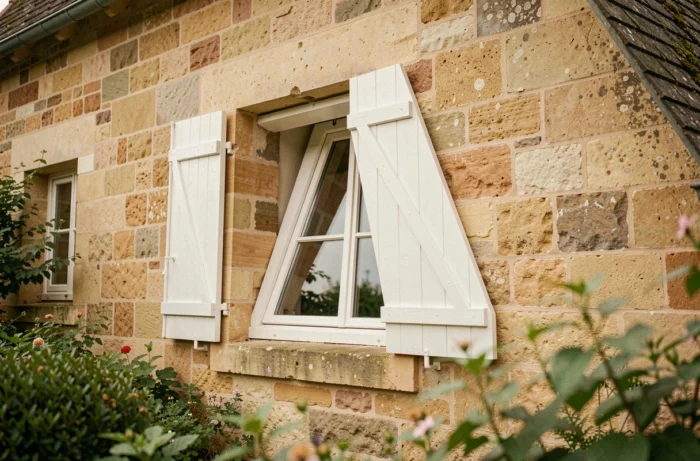
Covering a triangular window with a suitable shutter or blind presents a problem that rectangular joinery does not have: the geometry imposes technical constraints on the type of product, the mode of operation, and the final cost. Choosing a custom triangular window shutter involves balancing solar protection, thermal insulation, and mechanical feasibility, three parameters that behave differently on an inclined shape compared to a straight frame.
RE2020 Constraints on Triangular Glazed Gables
The environmental regulation RE2020, which applies to new constructions and, since January 1, 2023, to most residential extensions submitted for permits or prior declarations, has introduced a summer comfort indicator (DH). This indicator imposes effective solar protections on highly exposed openings, particularly on extensively glazed gables and inclined surfaces.
A triangular gable window without an effective external shutter or blind can fail the RE2020 thermal study, even if the insulation and glazing are compliant. For an extension larger than 50 m², solar protections become a regulatory requirement just like the performance of the joinery.
This point changes the logic of choice: the shutter on a triangular window is no longer just an aesthetic or security option; it is a component that enters into the thermal calculation of the building. The type of product selected (roller shutter, external blind, hinged shutter) directly influences the value of the solar protection coefficient considered by the engineering office.
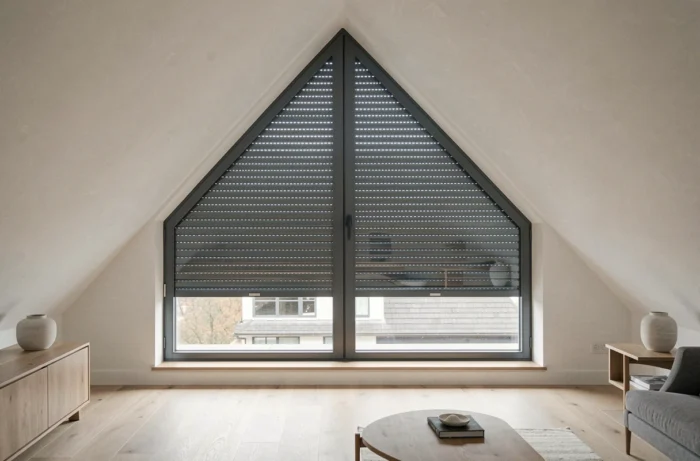
Roller Shutter, Blind, or Hinged on a Triangle Window: Technical Comparison
Not all shading systems are compatible with triangular geometry. The table below summarizes the characteristics of the three families of products applicable to this type of joinery.
| Type of Protection | Triangle Compatibility | Possible Motorization | External Solar Protection | Cost Increase Compared to Rectangular |
|---|---|---|---|---|
| Trapezoidal/Triangular Roller Shutter | Yes, with asymmetrical slats and adapted box | Yes (reverse or standard motor depending on configuration) | Yes | Significant (specific manufacturing) |
| External Screen or Fabric Blind | Yes, guided on cables or inclined tracks | Yes | Yes | Moderate to high |
| Custom Hinged Shutter | Possible in cut wood or aluminum | No (manual only) | Yes | Variable depending on material |
The roller shutter for triangular windows operates with slats attached on one side at the beginning of the run, then gradually completing. Some manufacturers offer a box placed under the window with a lifting system, which reverses the usual direction of operation.
Choosing a custom triangular window shutter involves checking the maximum allowable width, as trapezoidal models rarely exceed 2,200 to 2,300 mm in width without resorting to coupling two shutters.
On the other hand, the external cable blind offers more dimensional flexibility on large triangular glazed surfaces. It does not provide the same resistance to break-in as an aluminum roller shutter, but its solar protection remains comparable for the RE2020 calculation.
Materials and Motorization for Triangular Shutters
The choice of material determines both the durability, weight, and motorization possibilities of the shutter.
Aluminum or PVC on Special Shapes
Aluminum remains the dominant material for roller shutters on atypical window shapes. Its rigidity allows for the manufacture of asymmetrical slats that maintain their alignment in inclined tracks. PVC, being more flexible, is suitable for small dimensions but can deform under stress on widths greater than 1,500 mm in triangular configuration.
Aluminum better withstands the mechanical stresses of inclined tracks than PVC, which explains its predominance in this segment. Wood remains an option for hinged shutters cut to the exact shape of the triangle, particularly in areas subject to architectural prescriptions (ABF, protected sector).
Wired, Radio, or Solar Motorization
The motorization of a triangular shutter follows the same principles as a rectangular shutter, with one particularity: the motor must manage a variable load depending on the run (the first slats are short, the last cover the entire width). Standard tubular motors adapt to this constraint, but the adjustment of the end-of-travel requires finer calibration.
- Wired motorization is suitable for configurations where an electrical supply already exists in the box or lintel, which reduces installation costs.
- Radio motorization eliminates visible cable passage, an advantage on gables where the electrical path can be long.
- Solar motorization, with a panel integrated into the box, allows for installation without electrical work, but the surface of the panel must receive sufficient sunlight to power a large shutter.

Measuring and Pitfalls to Avoid on a Triangle Window
Measuring a triangular window is not limited to recording a base and a height. It is necessary to document the exact angle of each inclined side, as an error of a few degrees renders the shutter unusable. Specialized manufacturers generally require a full-size cardboard template or a laser survey.
The most common pitfall concerns the available space for the box. On a classic roller shutter, the box fits into the lintel or above the window. On a triangle, the peak leaves no horizontal space for a standard box. Two solutions exist: an external applied box placed on the lower part (with the curtain lifting), or a box integrated into the masonry if the construction allows it.
The question of coupling also arises as soon as the width exceeds the manufacturer’s limits. Two coupled shutters on the same triangular gable create a visible vertical joint and require synchronization of the motors for a uniform appearance.
The final choice depends on three measurable data: the exact glazed surface, the orientation of the gable relative to the sun, and the available space for the box. A thermal engineering office can confirm whether the chosen solution meets the DH indicator of the RE2020, which avoids having to modify the installation afterward.