The parental mental load is not just a simple organizational discomfort. The High Council for Equality, in a report published in September 2026, associates it with a significantly higher risk of depression, particularly among mothers without regular support. Anticipating, planning, coordinating the unexpected: what most guides call “family organization” actually encompasses a continuous cognitive workload whose effects on mental health are now documented.
Mental Load and Family Organization: Why Classic Tips Are Not Enough
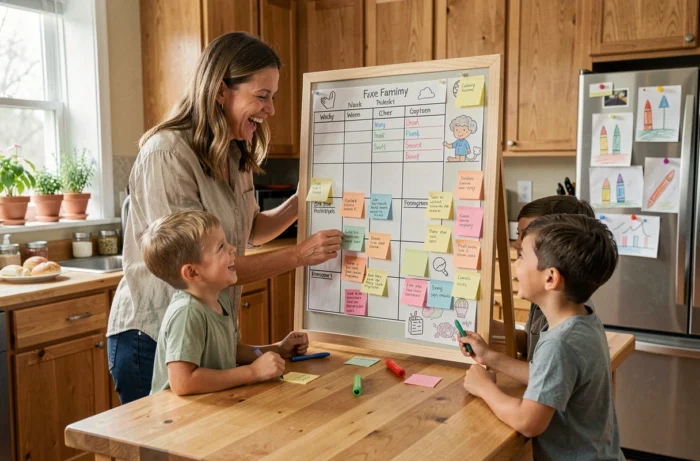
Wall planners, to-do lists, and color codes only address a superficial layer of the problem. We observe that these tools manage the execution of tasks, not their anticipation or coordination. The parental mental load precisely resides in this invisible layer: knowing that new clothes need to be bought for the school year, remembering to follow up with the doctor, ensuring that the lunch form has been sent back.
Reducing the mental load requires delegating cognitive responsibility, not just execution. A child who sets the table because they are asked does not lighten the parent’s mental load. A child who knows it is their role on Tuesdays and Thursdays, without reminders, begins to reduce it.
Resources like https://www.pcommeplimplim.com/ offer materials designed to support families in this logic of gradual empowerment rather than simple task distribution.

Cognitive Buffer: Creating Systems That Absorb the Unexpected
We recommend thinking in terms of “buffers” rather than exhaustive planning. A family schedule that is too rigid generates stress as soon as an unexpected event occurs, which happens several times a week in most households with children.
The principle of the cognitive buffer is to integrate margins into each routine. Concretely, this involves three levers.
- A block of unallocated time each evening (twenty to thirty minutes) that absorbs a delay in activity, a forgotten homework assignment, or an extra load of laundry, without derailing the rest of the evening.
- A rotating stock of “safety net” meals (three to four recipes mastered by all adults in the household, with ingredients always available) that eliminates the question “what’s for dinner” on days of fatigue.
- A list of independent activities for children, displayed and accessible, that allows them to occupy themselves without parental intervention when the buffer is consumed by an adult’s unexpected event.
The goal is not to anticipate everything, but to reduce the mental cost of the unexpected. Each functioning buffer system removes a loop of stress from daily life.
Empowering Children by Age: Beyond the Task List
Most guides offer task charts by age group. The problem is not the content of these charts, but their logic: they remain focused on execution, driven by the parent.
We recommend distinguishing three levels of family responsibility:
Execution Level (from 3-4 years)
The child performs a task upon request. Putting away their shoes, placing their plate in the sink. The parent bears the entire cognitive load.
Autonomous Routine Level (from 6-7 years)
The child knows a sequence and follows it without reminders. Preparing their bag the night before, following an evening ritual displayed in their room. The visual support replaces the parent’s verbal reminder.
Initiative Level (from 9-10 years)
The child identifies a need and responds to it. They notice that the trash is full and take it out. They see that they are out of bread and report it. This level is not taught through instructions but through a family environment where observation and initiative are valued.
The transition from one level to another takes time. Rushing the steps (assigning initiative level tasks to a five-year-old) produces the opposite effect: the parent ends up doing the task again, reinforcing cognitive dependence.

Screens and Parental Stress: The Underestimated Lever of Family Organization
Managing screen time has become a significant factor of organizational stress. Negotiating durations, managing conflicts around turning off, monitoring content: these micro-tasks add to an already saturated mental load.
Rather than setting rigid rules that are often circumvented, we recommend integrating screens into the buffer system described above. Screens become a family management tool when their use is contextualized: an episode during dinner preparation serves a different function than a “default” screen in the absence of alternatives.
The key lies in predictability. A known screen time slot, integrated into the child’s visual schedule, eliminates daily negotiation and the associated stress. The child does not ask; they know. The parent does not refuse; they refer back to the framework.
Couple and Distribution: Formalizing to Unload
The implicit distribution of tasks between parents is the primary generator of family tensions. “You could have thought of that” is the symptom of an organization based on unspoken expectations.
Formalizing does not mean creating an Excel sheet for every micro-task. It means assigning complete areas of responsibility. One parent manages medical appointments from start to finish (making appointments, accompanying, follow-up). The other manages extracurricular activities. Each area includes anticipation, not just execution.
This distribution by area rather than by task reduces coordination points between parents. Less coordination means less shared mental load, fewer “did you remember” moments, and less daily friction.
Stress-free family organization does not rely on more tools or lists, but on systems that gradually transfer the cognitive load from the parent to autonomous routines, buffers that absorb the unexpected, and a formalized distribution of responsibilities within the couple.