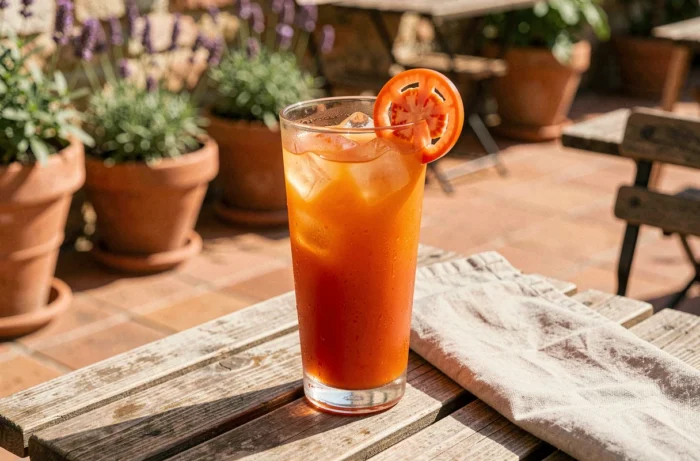
When you order a Tomate at the counter of a Provençal bar, the server doesn’t bat an eye. He grabs the bottle of pastis, measures the grenadine, and pours the cold water without hesitation. This cocktail, with its reddish-orange color, has been part of the aperitif landscape in the south of France for decades, and its preparation hides some subtleties that most online recipes overlook.
Pastis de Marseille: a regulation that changes the taste of the Tomate
Pastis is often referred to as a generic product, but not all pastis yields the same result in a Tomate cocktail. Ricard, for example, complies with the designation “Pastis de Marseille,” which adheres to a specific European regulatory framework.
This designation imposes a 45-degree alcohol content and an anethole content between 1.9 and 2.1 g/L. It is this aromatic compound, extracted from star anise or fennel, that causes the famous milky cloudiness when it comes into contact with water. The higher the concentration of anethole, the more pronounced the reaction, and the more the anise flavor dominates the mixture.
With a pastis from Marseille, the Tomate remains a significantly stronger cocktail than with an anise aperitif at 40 degrees. The traditional dilution (one part pastis to five parts water) is not a purist’s whim: it truly balances the bitterness of the anise and the sweetness of the grenadine syrup. Reducing the water results in a glass where the grenadine disappears beneath the anethole.
You can find the Ricard Tomate recipe detailed step by step, but understanding this dilution mechanism allows you to adjust the proportions to your own palate rather than following a dosage blindly.
Ricard Tomate Recipe: Dosages and Pouring Order
The recipe itself consists of four steps. Their order matters more than one might think.
- Pour 2 cl of pastis (Ricard or another pastis from Marseille) into a long drink glass or a balloon glass.
- Add 1 cl of grenadine syrup directly on the pastis, before the water. The syrup, being denser, mixes better with pure pastis than with already diluted pastis.
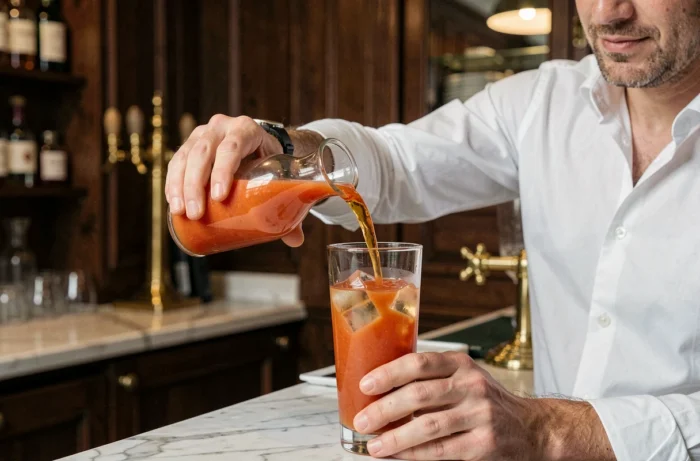
- Then pour about 10 to 12 cl of well-chilled still water in a steady stream. This is when the cloudiness appears and the color turns to the characteristic reddish-orange.
- Finish with ice cubes. Adding them last prevents blocking the mixing of the liquids and allows you to visually assess the dilution before chilling everything.
The most common mistake is to put the ice cubes in first. The pastis partially solidifies upon contact with the cold, forming oily aggregates on the surface, and the grenadine syrup remains trapped at the bottom of the glass. You end up with a layered cocktail instead of a homogeneous mixture.
Which grenadine to choose for the Tomate cocktail
Opinions vary on this point, but an artisanal fruit-based grenadine radically changes the result. Very sweet industrial syrups overpower the anise note and create a monochromatic cocktail in the mouth. A grenadine with real pomegranate acidity creates a sharper contrast with the anise.
The color is also affected: a natural syrup leans towards a deep pink, while an industrial syrup gives a bright almost fluorescent red. No impact on the technique, but the visual aspect of the glass is transformed.
Tomate, Mauresque, Perroquet: three pastis cocktails not to be confused
In the bars of southern France, the Tomate is just one of three classic variations of pastis with syrup. Confusions are common for those who did not grow up with this vocabulary.
- The Tomate: pastis + grenadine syrup. Reddish-orange color, sweet-anise flavor.
- The Mauresque: pastis + orgeat syrup (almond). Milky white color, sweet and round flavor.
- The Perroquet: pastis + mint syrup. Green color, dominant menthol freshness.
All three follow exactly the same preparation protocol. Only the syrup changes. The same proportions are used (2 cl of pastis, 1 cl of syrup, 10 to 12 cl of water) and the same pouring order.

What distinguishes the Tomate from the other two is its balance between sweetness and acidity. The Mauresque leans towards roundness, the Perroquet towards freshness. The Tomate, on the other hand, plays on a fruitier register that works particularly well in warm weather when one seeks a colorful aperitif without excessive complexity.
Tomate Cocktail and Provençal Aperitif: a ritual still firmly rooted
One might think that these pastis cocktails belong to a bygone era, that of black-and-white pétanque games. The reality is different. More than half of the French claim to have an aperitif at least once a week, and anise aperitifs remain a staple of this moment in the south of France.
The Tomate is part of a Provençal aperitif ritual that has never really waned. It is not a mixology bar cocktail. It is prepared at home, on a terrace, with a bottle of Ricard taken from the cupboard and a splash of grenadine. Its strength lies in this accessibility: no shaker, no rare ingredients, no special technique.
The name itself tells a story. No one orders a “Ricard grenadine” in Marseille. You say “a Tomate,” and everyone understands. This linguistic shortcut, shared with the Mauresque and the Perroquet, reflects a cultural anchoring that few cocktails can claim in France.
The next time you are offered a Tomate, you will know that behind this name lies a cocktail whose apparent simplicity rests on a regulated pastis, a precise preparation order, and a choice of grenadine that makes all the difference.