
A page torn from a book, without cover or title, with only the last words of the text as a clue: this is the kind of situation that transforms simple curiosity into a true literary investigation. When one comes across a fragment of a novel detached from its support, identifying the author requires a precise method, not vague intuition.
Textual clues to identify an author on an isolated page
Before searching on a search engine, it saves time to examine what is in front of you. The vocabulary used, the length of the sentences, and the language register already serve as an effective filter.
A text filled with technical terms related to navigation, geology, or machinery immediately points towards 19th-century scientific literature. If the page mixes detailed descriptions of natural phenomena with dialogues between characters in an exploration situation, the lexical field often points towards Jules Verne.
When trying to find out which author wrote on this detached page, the most direct method is to note a complete sentence, ideally the last or the first of the fragment, and to enter it in quotes into a search engine. This technique works in the majority of cases for published and digitized texts.
- Note the proper names (characters, places, ships) that appear on the page: a “Captain Nemo” or a “Lincoln Island” immediately clarifies the question
- Identify the narrative register: first-person narrative, omniscient narration, epistolary style, each narrows down the list of possible authors
- Examine the typography and layout: an old edition with long dashes for dialogues, a specific font, or footnotes points towards a time period and a publisher
- Look for a page number, a header, or a residual footer, sometimes partially visible on the edge of the sheet

Jules Verne and the motif of the mysterious page in The Mysterious Island
The enigma of the “detached page” frequently refers to Jules Verne, and more specifically to the novel The Mysterious Island. This is no coincidence: the entire structure of the novel is based on a mystery of identity.
In The Mysterious Island, a group of castaways stranded on a deserted island receives anonymous help that they cannot explain. The reader, like the characters, seeks to identify the hidden source behind these interventions. Verne’s narrative technique exactly reproduces the situation of someone holding a detached page: you have clues, but the author remains concealed.
A double sequel that recent criticism highlights
Recent studies on Verne emphasize that The Mysterious Island functions as a double sequel to Twenty Thousand Leagues Under the Sea and The Children of Captain Grant. The novel ties up several narrative arcs left open, notably that of Captain Nemo.
This reading of “hidden sequel” circulates more in academic criticism than in public discourse. Most readers know Twenty Thousand Leagues Under the Sea as Verne’s great novel, without realizing that The Mysterious Island is its continuation and resolution.
Jules Verne based his writing work on very thorough documentation. Far from the often-spread image of a visionary, he devoted a significant portion of his time to research. His meeting with publisher Hetzel in 1862 was decisive: Verne then committed to the project of a romantic encyclopedia aimed at youth, realized through the Magazine of Education and Recreation starting in 1864.
Concrete method when online research yields no results
Searching by exact citation in quotes sometimes fails, especially when the text has not been digitized or when the page comes from an uncommon translation. In this case, one turns to other approaches.
Contacting an antiquarian bookseller or a specialized librarian remains the most reliable solution for pages from rare editions. These professionals often identify a text based on typography, paper, and layout, without even reading the content.
One can also cross-reference several material clues:
- The type of paper (laid, vellum, bulk) and its wear state point towards a printing period
- The font and typographic conventions (French or English quotation marks, use of capital letters) vary according to publishers and eras
- A watermark visible by transparency can identify the paper manufacturer and thus narrow down the publication period
Responses vary on this point, but some specialized bibliophilia forums allow you to submit a photo of the page and obtain identification within a few hours. The community of collectors of old books is generally responsive to this type of challenge.
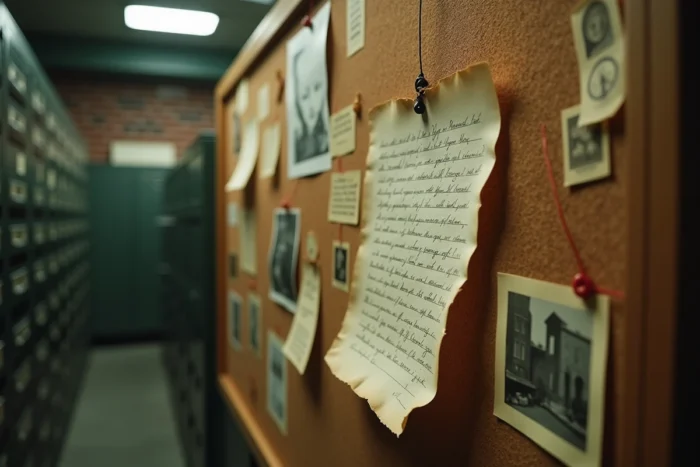
Why Jules Verne appears so often in this literary enigma
If you type “which author wrote on this detached page” into a search engine, Jules Verne dominates the results. Several reasons explain this recurrence.
First, his novels have been published in a considerable number of formats and collections since the 19th century. Isolated pages from his works circulate in flea markets, lots of old papers, and auctions. It is easier to come across a fragment of Verne than a fragment of Flaubert, simply because his books were printed in massive quantities for a young readership.
Next, Verne’s style lends itself to the identification exercise. His detailed scientific descriptions, characteristic dialogues, and memorable character names (Nemo, Aronnax, Cyrus Smith) function like signatures. Even a short excerpt of two paragraphs is often enough to recognize his writing.
Finally, The Mysterious Island occupies a special place in school curricula and recent educational editions. This integration is later than that of Twenty Thousand Leagues Under the Sea, which was long favored in teaching. The novel gains visibility, and with it the questions surrounding its pages and narrative mysteries.
Identifying an author from a detached page remains an exercise that combines material observation and literary culture. The reflex of online research by exact citation resolves most cases. For older fragments or rare editions, paper, typography, and the help of a specialist take over.