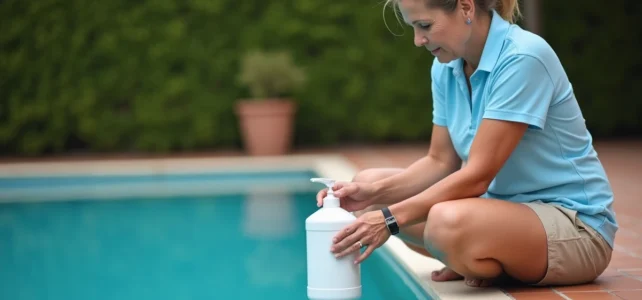
Clarifier and chlorine are among the most common products used in pool maintenance. When the water turns cloudy despite a correct chlorine level, the temptation to pour both into the pool without delay is strong. The question of mixing comes up every summer on forums and support groups, often with contradictory answers. Here’s what technical guides and field feedback allow us to affirm.
Chemical reaction between chlorine and clarifier: what happens in the pool
The clarifier works by coagulation: its polymers agglomerate suspended microparticles (dead algae, dust, organic residues) into clumps large enough to be captured by the filter. Chlorine, on the other hand, is an oxidizer whose role is to destroy microorganisms and burn organic matter.
Theoretically, these two mechanisms do not oppose each other. However, introducing them at the same time into the pool poses a concrete problem. A direct mixture can cause an exothermic reaction, meaning a sudden increase in temperature in the contact area, accompanied by the release of irritating gases. This risk exists especially when the two products come into concentrated contact, for example in a bucket, a skimmer, or an automatic doser.
The possibility of using clarifier and chlorine at the same time in a treatment protocol is therefore real, provided that they are never physically mixed before dispersion in the volume of water in the pool.
Delay between chlorine and clarifier: the rule of filtration hours
Recent safety guides have tightened their recommendations on this point. The principle is simple: each product must be dispersed and diluted before adding the next one. Filtration in operation is the non-negotiable condition for this dilution to occur correctly.
In practice, the most common protocol follows this order:
- First, adjust the pH of the water (ideally between 7.2 and 7.4), as a pH that is too high reduces the effectiveness of chlorine and alters the action of the clarifier.
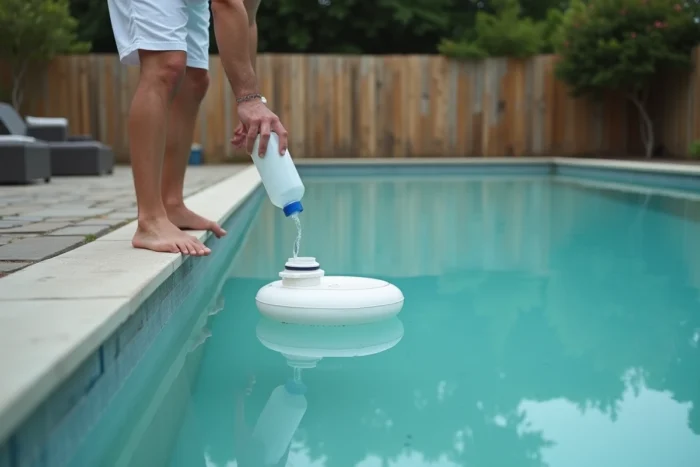
- Pour the chlorine (shock or maintenance) directly into the pool, with the pump running, and let the filtration run for several hours for even distribution.
- Add the clarifier only after this complete filtration cycle, pouring it in front of the return jets to facilitate distribution.
The exact delay between the two products depends on the pool volume and the pump flow rate. A complete filtration cycle (the time required for the entire volume of water to pass through the filter) constitutes the reasonable minimum. On most residential installations, this represents several hours.
Clarifier and filter type: compatibility to check first
Before even considering the question of mixing with chlorine, a technical point deserves attention. Not all clarifiers are compatible with all filters. The fundamental distinction lies between flocculants and clarifiers, two terms that are often confused.
The flocculant forms larger aggregates that settle at the bottom of the pool. It works well with a sand filter, capable of retaining these clumps when switched to “waste” position or after manual vacuuming. In contrast, a flocculant poured into a circuit equipped with a cartridge filter risks clogging the cartridge within a few hours, rendering filtration ineffective.
The clarifier itself produces finer aggregates, compatible with cartridge filters. This distinction should guide the choice of product, well before the timing question with chlorine arises. A poor choice of clarifier clogs the filter faster than the water clears up.
Cloudy water despite chlorine and clarifier: causes that chemical treatment does not resolve
Sometimes the water remains milky or greenish after a treatment combining shock chlorine and clarifier. Feedback from support groups shows that this situation is common, and it almost always points to a problem upstream of the chemical treatment.
First cause: insufficient filtration time. Pouring products into water that does not circulate enough is like treating a symptom without correcting the cause. The pump must run long enough each day, depending on the water temperature.
Second cause: a clogged filter. The clarifier agglomerates the particles, but it is the filter that captures them. If the filter media (sand, cartridge, diatomaceous earth) is saturated, the particles return to the pool. A backwash or cartridge replacement before the clarifier treatment radically changes the result.
Third cause: a pH imbalance. A pH above 7.6 significantly reduces the disinfecting action of chlorine and alters the behavior of the clarifier. Correcting the pH before any treatment is not generic advice; it is the condition for the products to work as intended.
Safety and storage: mixtures to never make
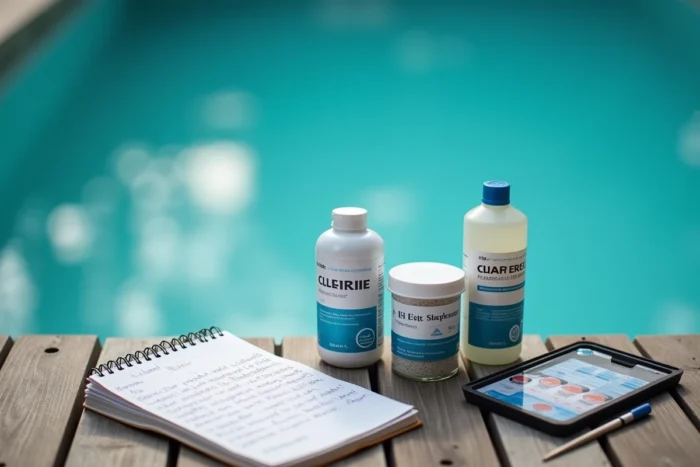
Warnings have intensified in recent years regarding combinations of pool products. The basic principle remains the same: never mix two pool chemicals in the same container. This rule applies to the chlorine-clarifier pair, but also to chlorine combined with an algaecide, a pH corrector, or any other treatment product.
The risks are not limited to the pool. Storing products in a poorly ventilated technical room, with open containers side by side, can be enough to cause emissions. Keeping containers closed, separated, in a dry and ventilated place is common sense but is often neglected.
On the pool side, an additional precaution applies: do not swim during treatment or in the hours following the addition of shock chlorine. The clarifier alone does not present the same skin risk, but as long as filtration has not completed its cycle after the last product is added, it is better to stay out of the water.
Treating cloudy water with chlorine followed by clarifier works in the vast majority of cases, provided the order of addition, the filtration delay, and compatibility with the existing system are respected. When the water does not respond to treatment, the problem rarely lies in the products themselves, but in filtration or the basic chemical balance.