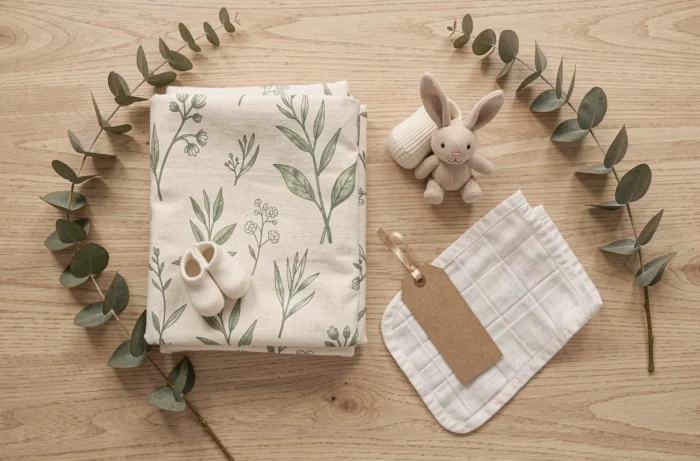
Textiles for newborns are no longer just a choice of colors or patterns. The chemical composition of fibers, surface treatments, and certifications now determine the actual quality of baby linens, far beyond the feel in-store.
PFAS and baby linens: what the European controls of 2025 reveal
The European CASP 2025 campaign highlighted a structural problem with children’s textiles. In France, the announcement published on September 1, 2026, indicates that only 40% of the ten tested items met the minimum requirements regarding PFAS. Sales bans, withdrawals, and recalls followed in several countries.
PFAS, used to give water-repellent properties to jackets, pants, and certain sleeping bags, pose a specific problem for baby linens. A bib or blanket marketed as waterproof may contain these persistent substances.
We recommend distinguishing between two cases. For items in prolonged contact with the skin (bodysuits, pajamas, fitted sheets), the Oeko-Tex Standard 100 Class I certification remains the most reliable filter, as it specifically covers textiles intended for babies. For water-repellent items (changing mats, mattress protectors), it is essential to verify that the treatment is based on fluorine-free alternatives, often made from wax or silicone.
A customizable baby pajama on Excargot illustrates this approach: the choice of certified cotton, combined with personalized embroidery, directs the gift towards an item that is both safe and personal.
Organic cotton and weight: technical criteria for baby bedding

The “organic cotton” label is not enough to guarantee a textile suitable for an infant’s sleep. The fabric weight determines thermal regulation and the durability of the linens. A fabric that is too thin pills after a few washes at 60 °C, the standard temperature for baby linen hygiene. A fabric that is too dense traps heat and increases the risk of overheating.
Specialized European manufacturers generally work with organic cotton jerseys with a sufficiently dense weight to withstand frequent washes while maintaining adequate breathability. The GOTS (Global Organic Textile Standard) certification regulates both cotton cultivation and dyeing processes, distinguishing it from a simple “organic” label without a precise reference.
Four criteria to check on a sheet or sleeping bag
- The textile certification (Oeko-Tex Standard 100 Class I or GOTS) is listed on the label or product sheet, not just in the marketing description.
- The country of manufacture is mentioned in accordance with European textile labeling regulations, allowing for verification of manufacturing conditions.
- The fabric can withstand washing at 60 °C without shrinkage exceeding the manufacturer’s standard.
- The absence of fluorinated water-repellent treatment is explicitly stated for waterproof items (mattress protectors, changing mats).
Textile birth gifts: comforter, bath cape, and personalized gift sets
Personalization through embroidery has become the standard for birth gifts in recent years. Names, initials, or birth dates appear on comforters, bath capes, and bibs. This trend meets a specific need for parents: to quickly identify their child’s belongings in daycare or with a nanny.
The embroidered comforter remains the most commonly given birth gift in textile gift sets. Its perceived value lies as much in its emotional use as in its function as a sensory marker for the infant. We observe that models made from organic cotton with an integrated pacifier attachment are gaining ground, combining two functions into one object.
Birth gift sets: compose rather than buy pre-made
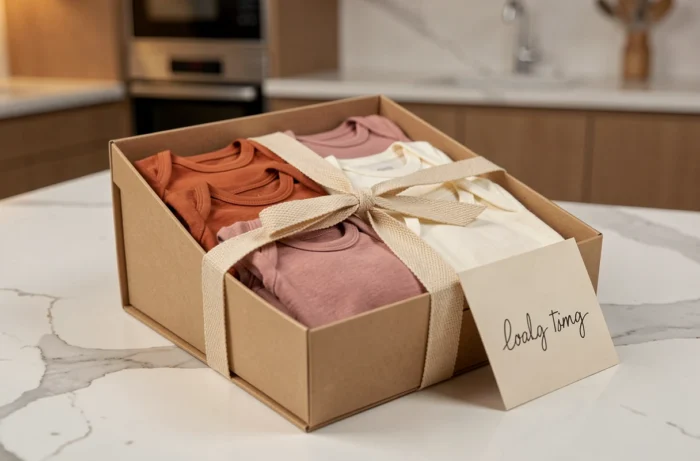
Pre-assembled gift sets sold in supermarkets often suffer from an imbalance: too many decorative pieces, not enough useful linen. Composing a custom gift set allows for targeting the actual needs of the first months.
- A bodysuit or pajama in size 3 months (newborn size is often worn for less than two weeks).
- A bath cape made of organic cotton terry, more durable than a standard towel and usable up to 18 months.
- A set of bandana bibs, more absorbent than flat bibs and suitable for the teething phase.
- A flat comforter with certification, small enough to meet sleeping recommendations.
GPSR regulation and traceability: what changes for online purchases
The European regulation on general product safety (GPSR), applicable since December 13, 2024, modifies the obligations of online sellers of baby linen. Each product sold must now display complete traceability information, including on marketplaces.
In practice, this means that a birth gift purchased on a third-party platform must include the name and address of an economic operator based in the European Union. Small creators selling through marketplaces are directly affected: without these mentions, the product may be withdrawn from sale.
For buyers, this regulation offers a concrete lever. If the product sheet of a pajama or sleeping bag does not mention a manufacturer or identifiable importer in the EU, it is a warning signal. GPSR compliance becomes a selection criterion on par with material or design.
The market for newborn linens is gradually structuring around these regulatory requirements. French and European brands that invest in certification and traceability are mechanically distinguished from imports without documentation. For a birth gift, choosing a textile with a documented production chain remains the best guarantee of actual quality.