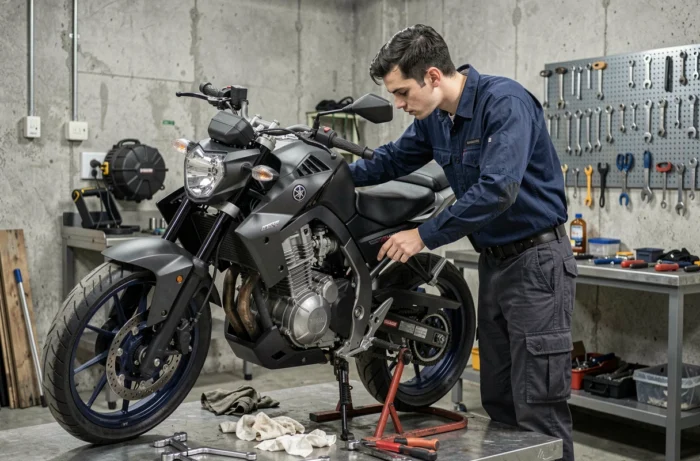
The MT 125 is based on a single-cylinder four-stroke engine with electronic fuel injection, whose power is restricted from the factory to comply with the A1 category. Any attempt to modify it simultaneously affects the engine mapping, the exhaust system, and the transmission, three interdependent parameters. Here, we detail the technical points that most guides overlook, along with their real consequences on the mechanics, compliance, and safety.
ECU Mapping and Engine Richness on the MT 125
The ECU of the MT 125 manages the ignition timing, injection timing, and cut-off at maximum RPM. Modifying the mapping without measuring the engine richness is akin to driving blind. A poorly calibrated reprogramming degrades starting, consumption, and reliability.
We observe that additional boxes sold online often merely trick the lambda sensor signal or push back the rev limiter. The engine then runs with an inappropriate air-fuel mixture, causing localized overheating of the exhaust valves and accelerating piston wear.
Before any intervention on the mapping, a dynamometer run allows for tracing the original torque curve. After modification, a second measurement confirms (or refutes) the actual gain and checks that the richness remains within an acceptable range.
Without this before/after measurement, it is impossible to know if the reprogramming has truly allowed to unrestrict the MT 125 to increase its maximum speed or if it has simply shifted the torque curve towards higher RPMs at the expense of low and mid-range.

Exhaust and Intake: Real Gains on a 125 Four-Stroke
Replacing the original exhaust system with a freer collector modifies the back pressure. On a single-cylinder engine of this displacement, back pressure contributes to filling: completely removing it results in a loss of torque at low RPMs. The gain at high RPM rarely exceeds a few percent without recalibrating the injection.
On the intake side, a sport air filter allows for greater airflow, but the original ECU does not automatically compensate for the excess air. The mixture becomes leaner, combustion heats up more, and the risk of knocking increases. Combining a sport filter and a free exhaust without touching the mapping often yields worse results than the factory configuration.
Transmission: The Often Overlooked Lever
Modifying the transmission ratio (output sprocket or crown) does not change the engine’s power but redistributes the effort between acceleration and top speed. Installing an additional tooth on the output sprocket lengthens each gear. The engine reaches its cut-off RPM later in actual speed, which pushes back the theoretical maximum speed.
This modification remains the simplest to perform and the most reversible. It neither alters the mapping nor the emissions. However, it puts more strain on the clutch and chain during acceleration. We recommend checking the chain tension and the condition of the sprockets after a few hundred kilometers.
Administrative Compliance and Motorcycle Technical Inspection
Any power modification calls into question the characteristics listed on the registration certificate. The vehicle no longer corresponds to its original certificate of conformity, which may lead to a requirement for individual approval from the DREAL.
Since the gradual implementation of technical inspections for motorized two-wheelers in France, the checked points include noise level and emissions. An unapproved exhaust or a mapping that alters pollutant emissions results in a refusal. Insurance constitutes a second barrier: in the event of a claim, the insurer may invoke the vehicle’s non-compliance to refuse compensation.
- The certificate of conformity and the registration document mention the maximum approved power; any discrepancies noted during an inspection expose the vehicle to immobilization.
- An exhaust without homologation marking (the letter “e” followed by a number) is a reason for a re-inspection at the technical control.
- The cancellation of the manufacturer’s warranty is systematic as soon as an ECU reprogramming or an unapproved engine kit is detected by the Yamaha network.

Mechanical Safety After Unrestricting the MT 125
The ABS braking system of the MT 125 is calibrated for the original power and weight. Increasing the top speed without adapting the brakes creates an imbalance: the stopping distance increases, and the ABS system intervenes on parameters that no longer correspond to the vehicle’s actual dynamics.
The chassis, suspensions, and tires are sized for the homologated power. A gain of a few horsepower may seem trivial, but on a lightweight frame designed for the A1 category, the effect is felt during hard braking and in fast corners.
Checkpoints After Any Modification
- Check the pressure and hardness of the brake pads, as the original discs are not designed for deceleration from significantly higher speeds.
- Inspect the steering play and the tightening of the wheel axles: the additional vibrations related to a higher engine speed fatigue the fastening points.
- Monitor the engine temperature on the first rides, ideally with an infrared thermometer at the cylinder and cylinder head.
The single-cylinder engine of the MT 125 remains a low-displacement engine whose power gains from modifications remain structurally limited. Each intervention (mapping, exhaust, transmission) produces a measurable effect only if accompanied by a dynamometer diagnosis and a compliance check. An unrestricting that is not followed by a global recalibration weakens the engine without guaranteeing an exploitable gain on the road.