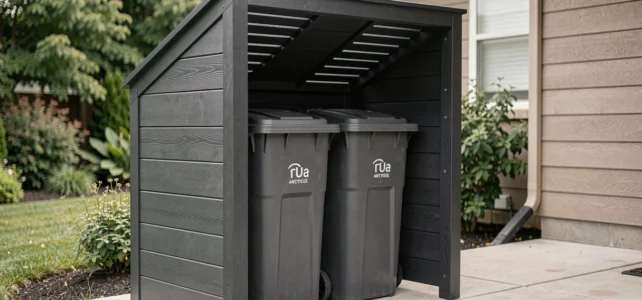
When you have three bins lined up against the facade (household waste, packaging, and now organic waste since the sorting obligation came into effect on January 1, 2024), the question is no longer whether to hide the bins, but how to organize daily access without turning the garden into a storage area. A bin shelter addresses this concrete problem, provided you don’t make mistakes regarding dimensions, material, and type of opening.
Bin Shelter and Organic Waste Sorting: Size Before Choosing the Style
Most buyers start with the number of existing bins. A few years ago, there were two containers per household. With the mandatory sorting of organic waste, many municipalities are distributing an additional bin or an individual composter. The result: a shelter designed for two bins becomes too narrow even before it is installed.
Before browsing the catalog, measure the combined width of the containers while adding a margin for handling. A 240-liter bin generally measures around 60 cm wide. Three bins side by side take up almost 2 linear meters, not counting the space needed to open a lid or pull a bin towards you.
At Brico Dépôt, you can find simple, double, and triple models. The triple bin shelter remains the most suitable format for the new sorting requirements, but it occupies a significant ground area. On a narrow plot, a depth model with front access may be more appropriate than a lateral alignment.
To compare available references, a bin shelter at Brico Dépôt allows for quick identification of configurations suitable for two or three containers.
Wood, Steel, or Resin: What Material for a Durable Bin Shelter
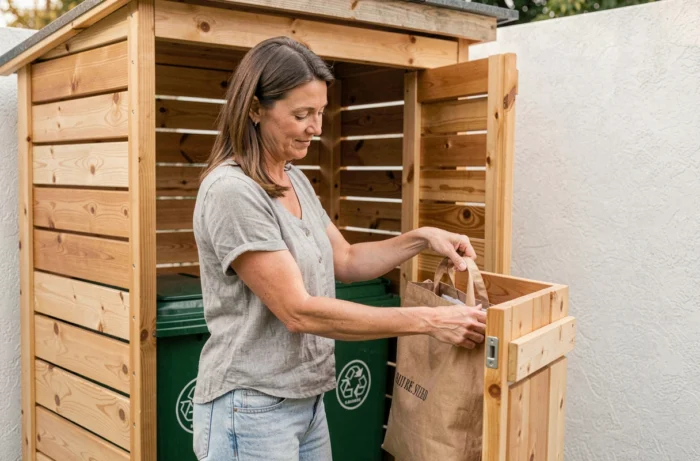
The choice of material is not just a visual preference. We are talking about a structure exposed to the elements, waste projections, and sometimes animal scratches. Each option has its maintenance constraints, and feedback varies on this point depending on the exposure of the site.
Treated Autoclave Pine and Composite Wood
Wood remains the most common material in shelters sold in DIY stores. Treated autoclave pine resists fungi and moisture for several years without additional treatment. Composite wood does not gray and does not require staining, but its price is higher.
A wooden shelter easily integrates into a garden or against a fence. The limitation: you must check that the treatment adequately covers contact with the ground, especially if the shelter rests on a damp slab.
Galvanized Steel and Powder-Coated Aluminum
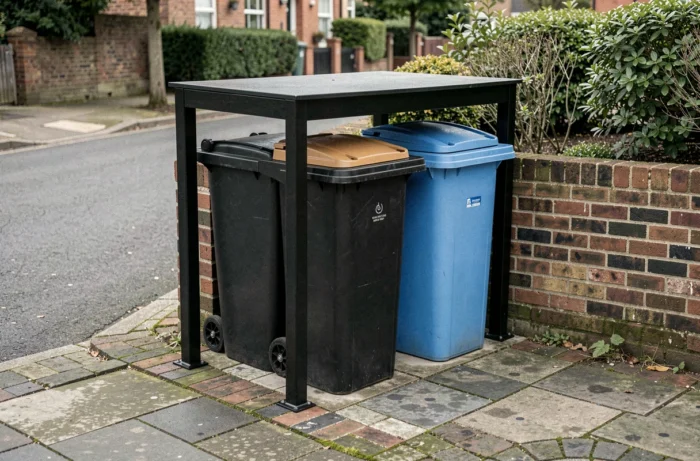
Galvanized steel offers good rigidity for a reduced footprint. Models in anthracite or black sheet metal fit into a contemporary style. Powder-coated aluminum is a step up: lighter, rust-resistant, but rarely offered at entry-level prices in DIY stores.
For street-side use, where impacts are frequent, galvanized steel withstands impacts better than resin.
Woven Resin and Polypropylene
Resin appeals due to its total lack of maintenance and its garden furniture appearance. It can be cleaned with a water jet. The downside: under high heat, some low-end polypropylene models can warp or become brittle after a few summers.
Type of Opening: The Detail That Changes the Evening Chore
The impact of the opening system on actual use is often underestimated. Taking out a trash bag with one hand while holding a lid with the other is the kind of scenario you discover after purchase.
- Front-opening double doors: the most practical for extracting the full bin on collection day without having to lift anything. Ensure that the doors do not block against a wall or hedge.
- Top flap (chest type): suitable for quickly throwing away a bag, but inconvenient when needing to pull out a heavy bin. Some models combine a flap and a front door.
- Side sliding panel: a compact solution for narrow spaces, but handling is less intuitive and the rail collects dirt.
The best compromise for daily use remains the double opening: a flap for depositing waste throughout the day, and a front door for taking out the bins on collection day.
Preliminary Declaration and Rules for Installing a Bin Shelter
This point is rarely mentioned in product sheets, yet it can block a project. Under urban planning law, any new construction over 5 m² of ground area is subject to a preliminary work declaration with the town hall.
The majority of commercially available bin shelters remain below this threshold. A standard triple model occupies between 2 and 4 m² on the ground. However, you exceed this if you combine the bin shelter with a storage chest or an adjoining technical room.
Another constraint to check: the co-ownership regulations or the specifications of the subdivision. Some municipalities require the concealment of waste containers, especially in heritage areas. In this case, the shelter is not an aesthetic choice but an obligation.
Before fixing the shelter, also check the distance from the public road. A container too far from the collection point requires crossing the garden every week, which wears out the lawn and motivation.
Concrete Selection Criteria for a Stylish and Functional Shelter
The word “design” on a product sheet guarantees nothing. What matters in daily use:
- The anthracite or matte black color hides stains better and ages more cleanly than white or beige.
- An integrated floor or a raised base prevents stagnant water under the bins, which reduces odors in summer.
- Hydraulic struts on the flap prevent slamming and extend the lifespan of the hinges.
- Ventilation through slats or shutters limits condensation inside, a detail often absent from entry-level models.
It is also beneficial to choose a model with individually replaceable panels. On a wooden shelter, a damaged slat can be replaced without dismantling the entire structure. On a monobloc resin model, a significant impact can compromise the entire structure.
The final choice depends as much on the available space as on the number of bins to accommodate. With the addition of the organic waste container, it is better to plan for an additional space at the time of purchase rather than having to replace the shelter in two years.