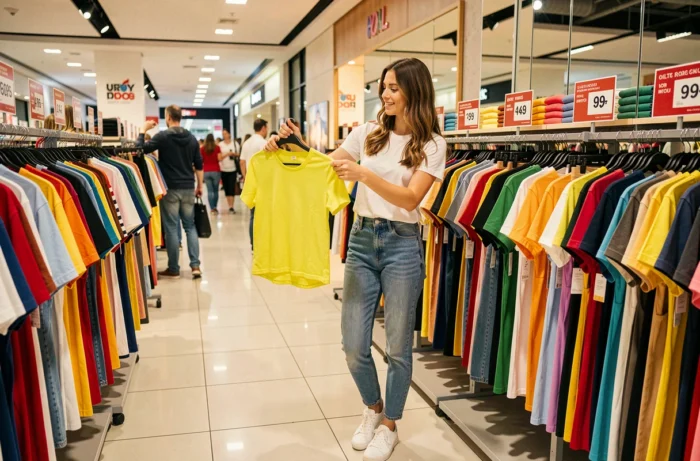
A parent who has to clothe three growing children for the new school year doesn’t compare eco-friendly labels: they look at the total price in their shopping basket. This instinct, shared by millions of French households, fuels a massive flow of low-cost new clothing purchases every year.
In France, an estimated 3.25 billion new items are put on the market in the textile, clothing and footwear sector, according to data from the General Secretariat for Ecological Planning. Understanding who buys fast fashion, and above all why, means looking beyond the stereotype of a teenage girl hooked on Shein.
Buying new at low prices for lack of alternatives: budget constraints come first
Budget remains the main driver of low-cost clothing purchases. A 2023 Refashion survey on second-hand shopping habits indirectly confirms this: even when buying pre-owned, budget is cited as the main reason, ahead of enjoyment and the desire to avoid waste. When purchasing power dictates choices, unit price wins out over durability.
Single-parent families, students and low-income workers all face a simple calculation. A four-euro T-shirt from an ultra-fast-fashion retailer meets an immediate need. Second-hand clothing, despite its growth, doesn’t always meet that need. To identify the biggest fast fashion consumers in France, it’s clear that income matters as much as, if not more than, age or an interest in trends.
There are practical situations where second-hand shopping doesn’t work:
- Children outgrow their clothes every six months, making thrift-store searches time-consuming, with no guarantee of finding what’s needed.
- Standardized workwear (lab coats, safety shoes) is rarely available second-hand in good condition and in the right size.
- Plus sizes and atypical body shapes remain underrepresented on resale platforms, pushing shoppers toward standardized new clothing.
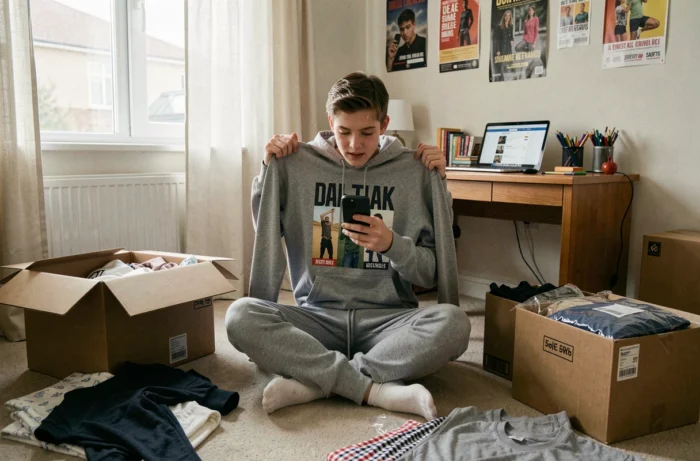
Fast fashion shoppers: the young, female stereotype needs nuance
2024 YouGov data point to women and parents of minor children as the vast majority of fast fashion customers. This is true, but it masks a more complex reality.
Those aged 18–34, often described as the core target market, actually have mixed shopping habits. IFM data for the first half of 2025 show that this age group spends a larger share of its clothing budget on second-hand items than older consumers do. Buying something on Vinted on Tuesday and placing a Shein order on Friday is hardly contradictory when you’re twenty-three and on a tight budget.
Reducing the typical shopper to a teenage girl influenced by TikTok overlooks several groups:
- Men aged 25 to 40 who buy basics (T-shirts, joggers) online in multipacks, with no particular brand loyalty.
- Parents who replenish the family wardrobe in bulk, prioritizing price per item.
- Retirees on modest pensions who shop at physical retailers such as Kiabi or Primark out of habit and because they’re nearby.
An October 2025 Ipsos study notes that almost all French people are familiar with Chinese low-cost fashion retailers. Shein’s brand awareness spans all age groups, further undermining the idea of a single type of consumer.
Social media and impulse buying: an accelerator, not a cause
It’s often said that TikTok and Instagram create fast fashion shoppers. Social media does play a real role in how quickly trends come and go: a Shein haul can rack up millions of views and normalize buying dozens of items in a single order. This mechanism is well documented.
But blaming mass clothing consumption solely on algorithms means confusing the trigger with the underlying conditions. Those conditions are constrained purchasing power and an offer just two clicks away. Without rock-bottom prices, viral content wouldn’t convert as many shoppers.
Online fast fashion is booming in France because it removes friction. No travel, no queues, free returns. For a household in a suburban area without easy access to thrift stores or ethical brands, ordering low-cost clothing online becomes the path of least resistance.
Second-hand shopping is growing: why it hasn’t replaced fast fashion yet
The second-hand market is growing in France, driven by platforms such as Vinted. IFM now measures its share of clothing spending. This growth is real, but it doesn’t automatically take sales away from fast fashion.
The two channels often coexist for the same consumer. Someone might resell a coat on Vinted to pay for a Shein order. Second-hand shopping and fast fashion feed into each other rather than compete.
Several barriers are slowing the shift to second-hand. Searching takes more time: finding a specific item second-hand requires patience, a luxury when you’re managing a household. And without trying it on, quality is uncertain.
Ultra-fast-fashion items themselves also have such short lifespans that they rarely make it into the resale market, creating a vicious cycle: low-end new clothing produces items that are difficult to resell, so they don’t add to the second-hand supply.
The broader economic context also plays a role. In 2024, the Directorate General of the Treasury reported a high household savings rate, reflecting tight budget trade-offs. When people save for a rainy day, clothing spending takes a back seat, and fast fashion captures what remains of the clothing budget.
Fast fashion consumption in France is neither a generational whim nor an addiction to social media. Above all, it reflects financial constraints that neither second-hand shopping nor ethical brands can yet address for every type of consumer. As long as buying new clothes at very low prices remains the easiest and cheapest option, purchase volumes won’t fall through consumer goodwill alone.